The long awaited Avi Chai Foundation Hebrew report, Hebrew For What? Hebrew at the Heart of Jewish Day Schools, was released this month, and is enjoying broad discussion and commentary among Hebrew educators and administrators.
While I read it closely and with great interest, I was left scratching my head, surprised both by its content, and by what failed to make its way into the hefty 64-page volume.
On this Pesach 5777, our season of fundamental questions, let’s start with the report’s Executive Summary, which, right off the bat, outlines some of my concerns. As the summary opens, its researcher/authors lament the difficult and complex task of teaching Hebrew, due to the multiple purposes that the Hebrew curriculum serves (studying both classical sacred texts, and acquiring modern Hebrew communication skills) in a day school setting. The authors seem to be seeking readers’ leniency by describing a nearly impossible feat, relating that Hebrew faculty is hard to find; instructional minutes are hard to come by; parental demands add stress; maintaining older students’ interest is challenging; and my personal favorite, the non-Romanized alphabet makes Hebrew harder to learn than other commonly taught world languages, such as Spanish and French.
Before we continue, I say we need to come to some common understanding about what it is we are trying to accomplish with Hebrew in the day school classroom, refine and articulate our goals regarding Hebrew instruction, and align our teaching with our goals. I believe that a better handle on Second Languages Acquisition (SLA) research, which is, lamentably, all but absent from the Avi Chai report, will aid our grasp of the issues above, and how to address them.
Big Idea #1: Humans acquire language one way only – by understanding messages (Chomsky/Krashen). If we want our students to acquire Hebrew for any purpose, sacred or secular, conversational or literary, then we must begin by delivering comprehensible input, aural/oral and written messages that they can understand and that are so compelling that they attend to them effortlessly and automatically.
The Avi Chai report researchers uncover a curious trend in their surveys. The day school kids, they report, seem to be losing their Hebrew ability after fifth grade! Interestingly, this deterioration of skill in not found elsewhere in the literature among students of other languages, nor is the Hebrew phenomenon explained in the report within any SLA framework. So I offer these fundamental questions:
Could it be that after 5th grade, many Hebrew programs shift from a more experiential, conversational, compelling comprehensible input (CCI)-rich communicative model, to a high-stakes grammar and vocabulary-heavy memorize-and-test grind (unsupported by any SLA research)?
Could it be that after 5th grade, Hebrew is no longer used as the lingua franca of the classroom, but that upper level teachers talk (in English) about how Hebrew’s grammar and syntax, morphology and phonology work? Such a focus on the surface of the language in lieu of language as a tool for communication is also unsupported by any of the best-practice research, and would come at the expense of CCI and its attendant student comfort and engagement. As the amount of CCI, overall program interest and therefore quality decline, so do student outcomes.
Could it be that some programs abandon communicating in modern Hebrew altogether after 5th grade, instead shifting their limited instructional minutes to classical sacred texts – using mostly English? This possibility would most certainly render the class less conducive to Hebrew language acquisition.
Recommendations: Create and defend an early start-long sequence modern Hebrew language program, rich in CCI, that broadens students’ linguistic foundation from year to year. Insure that the content is compelling by incorporating student interests and ideas. Integrate lots more reading into the program from an early age, with literacy materials connected to and based on the acquired aural/oral language. Reading compounds language gains, and can be leveraged for the study of sacred texts. The handicap of a non-Romanized alphabet can be overcome if students are exposed to appropriate reading materials over the long haul. Protect the time dedicated to modern Hebrew instruction; it is different from sacred text study, and should not be substituted at the beginner-to-intermediate levels. Educate faculty, parents and students about your new (department-wide!) approach. Demonstrate CCI lessons at go-to-school-night, which is sure to create a buzz. Parents will be more likely to support you if their children are happy and successfully learning, and they understand the framework and what you’re trying to accomplish.
Watch student enthusiasm take off and soar, alongside acquisition. While face to face modern Hebrew communication will grow proportionately with the amount of quality CCI, it will not keep pace with the complex concepts, parables, allegories and commentaries contained in the Hebrew sacred texts. Either these will have to be adapted for beginner to intermediate Hebrew learners’ needs, or their study will have to take place in English, or in combination of Hebrew and English, whichever arrangement best meets the linguistic needs of the students. We cannot hope to teach beginners’ basic modern Hebrew for daily communication, and Talmud Torah as it appears in its original form, on the same day. It’s like reading a high school social studies textbook to a kindergartner! We must adapt our Hebrew texts to meet the needs of our learners, insure our students are engaged and comfortable –  NOT STRESSED OUT or made to feel inadequate. A high affective filter can be a major obstacle to language acquisition, so we must be vigilant that we aren’t freaking out our kids, or they will tune out and turn off. And researchers will conclude that they are ‘losing their Hebrew language,’ when it’s really the program, itself, that has lost its way.
If it’s not clear by now, I am advocating for two (or more) entirely separate classes: modern Hebrew, and ‘Judaics’/sacred texts. Let’s treat modern Hebrew like the secular subject it is – like Spanish or French – and inform our instruction with both the tenets of Second Language Acquisition research and the intuitive strategies that have been embraced by thousands of world language teachers over the past 20+ years. Of course we’ll apply and enjoy the strong modern Hebrew literacy skills our students develop over in their classical Judaics/Talmud & Torah classroom, where they’ll also benefit from the linguistic knowledge they’ve gained in modern Hebrew class (general vocabulary, familiar verb forms, prefixes, transition words, etc.) The sounds and meanings are already in their heads! By starting with language for meaning – modern Ivrit – we will build capacity for the more intellectual pursuit of classical text analysis by prioritizing and insuring the development of comprehension, literacy skills, interest and confidence.
Big Idea #2: Listening comprehension and reading, the receptive/input skills, precede writing and speaking, the productive/output skills (Read this blog post).
 But they are, regrettably, also killing student (and teacher) interest and engagement, because the set curriculum is…OK I’ll say it: mind-numbingly boring. Set curricula often ‘covers’ static and humorless topics about which the students are not interested or passionate; nor do many of the themes incorporate the highest frequency words for greatest linguistic coverage.

 As we careen toward פסח and then to the end of another Hebrew school year, I’ve transitioned from my role as teacher trainer and lesson modeler, to coach and mentor. I enjoy observing and providing positive feedback to my colleagues as they experiment with their newly adopted teaching with comprehensible input (T/CI) strategies, and I continue to learn so much about how to support both our students’ Hebrew acquisition, and our teachers’ acquisition of the T/CI skills!
 and when possible, add a gesture and/or use a prop to help support understanding. And don’t forget, for our novice learners we can choose to substitute an oral instruction for an extra-linguistic prompt, as in gestures & facial expressions, which can be combined with props, pictures and sketches.







 using Hebrew in the lunchroom, and integrating Hebrew across the curriculum by singing Hebrew songs in Music class; employing Hebrew in Art, etc.
 So output-based (speaking, writing) assessments for beginners are inappropriate, because these novices are still building a linguistic foundation. Would you proctor a speaking test on a 14-month-old? Assessments of comprehension are formative and ongoing by the well-trained T/CI instructor. Evaluators can see in class if students demonstrate comprehension of the input; parents can see it in a
  a 7-week Hebrew immersion camp experience that my son attended. While he had a fantastic summer, the entrance test likely created obstacles and anxiety for many potential campers. It sends the message, ‘If you don’t know or memorize this random list of low frequency words, you aren’t a good fit.’ Is that the pronouncement we want to convey to our 15-year-olds? The study packet asks students to (be prepared to) memorize semantic sets (i.e. – a list of colors, nature words, numbers), but
  giving students ample invitation and opportunity to speak in more supported and natural ways. This point cannot be overstated. Often teachers and schools feel pressure to prove that their Hebrew classes are effective, by showing what the kids can say/do with the language (“using complete sentences!”) Instead, we must re-educate our whole community on the importance of investing our time and energies in CI, and showing how it works by: 1. Demonstrating T/CI on parents; 2. Inviting them to observe Hebrew class: 3. videotaping our classes so that observers can appreciate just how much Hebrew our kids are hearing, attending to, and comprehending. There is no research that I know of supporting forced output (“You may only speak Hebrew in gym class”) or language practice, (as in, “Repeat after me:”) as a pathway to proficiency – for beginners. On the contrary, Comprehensible Input provides the fertile soil from which speaking and writing (output skills) grow.
 But we know that young students (and most people, no?) like to talk about one thing more than any other – themselves! Therefore, setting a curriculum focused on exploiting the highest frequency words (& verb-containing chunks), while incorporating students’ interests and ideas through story-asking, is a fun, lively, engaging and creative way to customize classes for the group in front of you! Using hi-frequency verb-chunks to talk about “my house” or “my morning routine” is flat and boring, while collaborative, creative and personalized stories bring light and laughter into a discipline in which the brain is already working hard! We can decide upon a corps of foundational verbs we want to use, and recycle & add more each year to articulate a curriculum up through the grades, realizing full well that we may deviate while following student interest. The key to good language instruction is sustaining engagement and attention to the comprehensible message, while using Hebrew all the while.
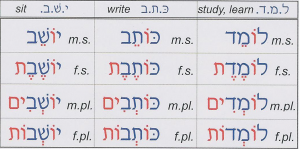 but when you delve further, it, too, is filled with conjugation charts, rules about masculine and feminine, singular and plural endings, and thematic vocabulary lists, like, “places in the house,” or, “weather expressions.”
 We need to scaffold the language, flesh it out, and communicate naturally, at the discourse level. No substitution drills. No scripted dialogues.
 But until then, she’ll feel sustained, supported, and balanced by the training wheels of a story-based written curriculum.

 *Elementary Pre-K to 2nd grade & 3rd to 5th grade sub-groups
 I knew we needed to keep playing with the hi-frequency language we’d used thus far, and I was wary to start introducing more new words. The previous (Sunday) Hebrew class was so short – I teach three consecutive 20-minute classes – and with transition and settling time, the kids barely get 12-15 minutes of Hebrew instruction. Wednesday’s 35-minute classes are the heart of the program.


 Our scene went absolutely NOWHERE. The initial query, “Are you tired?” set the docket for the rest of class. We simply and gleefully played with the unlikely possibility of taking a teacher-sanctioned nap in Hebrew class. We explored each actor’s interpretation, one after the next, affording lots of silliness, laughter, and compelling repetition.